
Introduction
Pakistan is the fifth populous country with a population of 207.775 million of which 63.6 % hire in rural areas and 36.4 in urban (GOP, 2017). ??Socio economic development is essential requirement for the improvement of the quality of life, wellbeing of the people and the environment in which we all live. Socio economic status is a combined economic and sociological measures of a person/a household/family in relation to other people in term of education, income and occupation. Any change in these indicators both positive and otherwise will affect the social economic status of a person or household or a family. ??Besides, there are other indicators which are also related to socio-economic status, such as health, wealth, political participation, psychological condition, household size, housing quality, safety and security, availability of food, basic need and other essential services.?? Thus, in order to improve the quality of life there is a need to improve the socio-economic conditions of the general masses through education, capacity building, skill development and creation of income generating activities so the people could have better occupation to earn more and contribute for their own and national development. By improving these indicators Pakistan will stand amongst the countries which have better Sustainable Development Goals (SDGs) and socio-economic indicators by the end of 2030.
According to recent economic survey 2016-17 the un-employed labour force in Pakistan is 3.62 million whereas the un-employment rate is 5.9%. The literacy rate of the country is 58% but for female it is 48%.?? The GDP per capita income is US $ 1629 which is very low as compared to other regional countries. With the inception of CPEC, more than US$ 59 billion foreign investment in infrastructure, energy, industrial cooperation through special economic zones (SEZs), and building of Gwader port and Gwader smart city and agriculture rural development will provide better opportunities for the enhancement of the socio-economic status of the people of Pakistan. According to a recent survey conducted by the Socio-economic division Centre of Exellene,CPEC more than 36000 Pakistani and 2000 Chines national are employed in direct job only in CPEC road infrastructure?? early harvest projects and more induced and indirect jobs are expected due to positive multiplier effects. Moreover, there will be profound improvement in the socio-economic status of the people of the country throughout by the end of the 2030s.
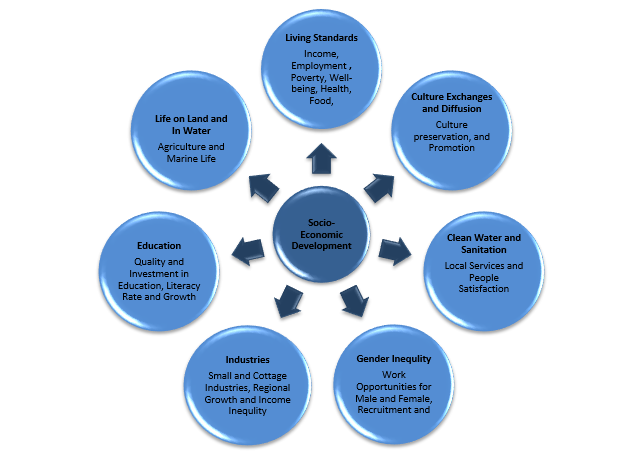
Framework
Research Goals
At Centre of Excellence for CPEC, Socio-economic built capacity for the collection and analysis of data for evidence base policy planning and intervention thematic area highlights the secondary or unpublished/published data.
Brief about the physical & socio-cultural environment of the study area including: –
- Land/area/location and location advantages/land use record which can be taken from the district revenue development including total area, agriculture area irrigated, means of irrigation, barani area, area not available for cultivation/banjer/forest, culturable waste etc.
- People, tribes, languages, culture, customs, traditions, ceremonies etc.
- Means of livelihood or main occupations in:
Primary sector e.g. agriculture, animal husbandry, fishing, mining, forestry.
Secondary sector e.g. industry both main & college
Tertiary service sector education, health & other government employment, specialized services, professionals, business, commerce, trade & accounts.
- Cropping pattern- main crops of all season high value crops. Marketing for agriculture other products.
- Local industry cottage and heavy.
- Population, household size, occupation, income, sex ratio, age, manpower (18-60 years old by various age groups), technical education, literacy, disable population, stunting & disability, employment, migration pattern, income sources, assets moveable/immovable.
- Availability of general facilities e.g. electricity, suigas, education health, roads, street lights, sewerage, drinking water supply, irrigation water, courts, police, safety and security, local government system and people satisfaction level (using five scale) from the delivery of local services.
- Housing size type structure (katcha, pacca, semi-pacca), tenure (owner, renter or rent free), access, street, pavement, Nearby health facility.
- Future prospects for employment generation and development local skills
- Poverty: availability of food.
Research Areas
Centre of Excellence CPEC is conducting research to quantify the socio economic impact of the CPEC portfolio on all walks of life in terms of:
- Macro Economic Impacts (GDP Growth, Employment Generation, Foreign Trade, Investment)
- Micro Economic Impacts (Poverty Reduction, Employment, health, education)
- Social Impacts (quality of life of general masses, cultural exchange, environment)
| Vision | To promote socio-economic development and prosperity through economic policies and planning for the benefit of society. |
| Mission | Understanding of growth and change processes, individual welfare and the behaviour and opportunities for general masses. |
| Proposed Research Area | ? CPEC and its implication for Human Capital Development in Pakistan.
? CPEC and class conflicts in term of Balanced growth ? CPEC and Economic integration ? CPEC and Institutional Reforms ? CPEC and Extremism in Pakistan ? CPEC and Changing Geo-Political Environment ? Implication of CPEC for Eradication of Poverty and Inequalities in Pakistan ? Environmental Implication of CPEC |
| Proposed Research and Possible Outcomes | CPEC as a solution to Counter Ethnic Insurgencies in Pakistan
? Causes of Ethnic Insurgencies in Pakistan ? Highlight the severity of insurgencies across different areas ? What measures under CPEC would be suggested to counter ethnic issues ? Way of Implementations Implications of CPEC for Poverty and Income Inequalities ? How CPEC can increase Employment Opportunities ? CPEC and its effects on Per-Capita Income of Households ? To find the implications of CPEC in Human Capital Development to eradicate poverty ? Suggest different measure to narrow down the gap between different income groups Success of CPEC in the presence of current institutional structure of Pakistan ? The current scenario of institutional quality of Pakistan ? To explore different institutional constraint in CPEC successful Implementations ? Suggest institutional reforms
|
| Long Terms Strategic Objectives of Thematic Area | 1.? To achieve Sustainable growth
2.? To enhance harmony among federating units 3.? To strengthen Geo-Political position of Pakistan in the region 4.? To Uplift the living standard of general masses |
Introduction
Pakistan is the fifth populous country with a population of 207,774, 520 of which 63.6 % is rural and the remaining 36.4 is urban (GOP, 2017). ??Socio Economic development is essential for the improvement of the quality of life and wellbeing of the people and the environment in which we all live. Its status is a combined economic and sociological measures of a person/a household/family in relation to other people.
There are three basic indicators which includes: education, income and occupation. Any change in these indicators both positive and otherwise will affect the social economic status of a person or household or a family. ??Besides, there are other indicators which are also related to socio-economic status. These are health, wealth, political participation, psychological condition, household size, housing quality, safety and security, availability of food, and other basic essential services.?? Thus, in order to improve the quality of life there is a need to improve the socio-economic conditions of the general masses through education, capacity building and skill development so the people could have better occupation to earn more and contribute for the national development. By improving these indicators, eradication of poverty will be possible and by the end of 2030, Pakistan will stand amongst the countries which have better Sustainable Development Goals (SDGs) and socio-economic indicators.
According to recent economic survey 2016-17 the un-employed labour force in Pakistan is 3.62 million whereas the un-employment rate is 5.9%.?? Overall, the literacy rate of the country including both sexes is 58% but for female it is 48%.?? The GDP per capita income in 2017 was US $ 1629 which is very low as compared to other regional countries. With the inception of CPEC, more than US$ 59 billion foreign investment in infrastructure, energy, industrial cooperation through special economic zones (SEZs) and building of Gwader port will provide better opportunities for the enhancement of the socio-economic status of the people of Pakistan. At present more than thirty thousand people are employed in the CPEC early harvest projects and more induced and indirect jobs are expected due to positive multiplier effects. Moreover, there will be positive change in the socio economic status of the people of the country throughout by the end of the 2030s.
Framework
Research Goals
At Centre of Excellence for CPEC, this thematic area highlights the secondary or unpublished/published data.
- Brief about the physical & socio-cultural environment of the study area including
- Land/area/location/land use broader categories record can be taken from the district revenue development e.g. total area, agriculture area irrigated, means of irrigation barani, area not available for cultivation/banjer/forest
- People, tribes
- Historical background
- Means of livelihood or main occupations
- Primary sector e.g. agriculture and animal husbandry, fishing, mining, forestry.
- Secondary sector e.g. industry both main & college
- Tertiary service sector if any e.g. education, health & other government employment
- Agriculture cropping pattern- main crops of all season. Speciality of the area agriculture if any near marketing for agriculture other products.
- Local industry cottage and heavy.
- Population, household head occupation & income, sex ratio, age, manpower (18-60 years old) (by various age groups), technical education, literacy, disable population, occupation & employment, migration pattern, income sources, and people local assets (moveable/immovable)
- Local service availability e.g. electricity, suigas, education health, roads, street lights, sewerage, drinking water supply, irrigation water, courts, police, safety and security, drainage, local government system and people satisfaction level (using five scale) from the delivery of local services.
- Housing type structure (katcha, pacca, semi-pacca), tenure (owner, renter or rent free), access, street, health pavement, stunting & disability. Nearby health facility.
- Future prospects for employment generation, local skills
- Poverty: availability of food for household in the last month.
Research Areas
Centre of Excellence CPEC is conducting research to quantify the socio economic impact of the CPEC portfolio on all walks of life in terms of:
- Macro Economic Impacts (GDP Growth, Employment Generation, Foreign Trade, Investment)
- Micro Economic Impacts (Poverty Reduction, Employment, health, education)
- Social Impacts (quality of life of general masses, cultural exchange, environment)
