
Introduction:
Pakistan has natures unique advantage due to its geo-strategically coordinates among top emerging eastern economies including China, India and other South Asian countries. World has experienced multiple regional integration models like EU, ASEAN, SAARC and BRICS. But these are all facing a lot of challenge. Major root-cause being exclusive growth of regional countries. Based on such experiences, President Xi initiated a new model of regional integration Belt and Road Initiative (BRI) and made connectivity agreements with 65 regional countries for infrastructural development worth 900 billion USDs.
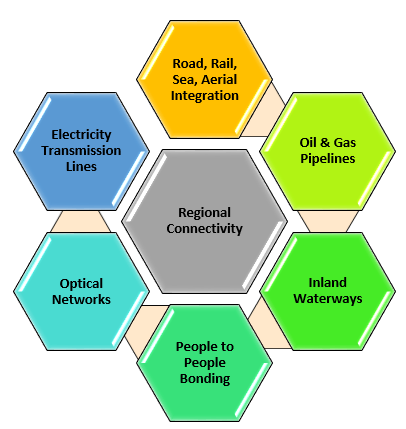
Under BRI model China is going to connect South Asia, South East Asia, Africa, Europe, Central Asia, Russia and Middle East Asia with six major economic corridors and China Pakistan Economic Corridor (CPEC) has been declared a flagship corridor of BRI due to its geo-strategic positioning. Regional Integration became a necessary seed in the field of economic prosperity by boosting connectivity through internal and external linkages. Under this model eastern emerging economies will be interlinked with each other through diverse modes: roads, rails, energy lines, communication networks, dry ports, sea ports, aerial and people to people.
Framework:
Research Goals:
Our research focuses on CPEC infrastructure towards improvement of connectivity chains, analysis of the alternative optimal routes for regional connectivity through Gwadar Port and exploring the feasible connections among Central Asia, China, South Asia, Middle East, Africa and Europe.
Key Research Areas/Topics:
- Estimation of freight flows through CPEC land routes in short, medium and long term
- Freight and passenger flows bottlenecks identification for infrastructure enhancement
- Examine the Chinese GVCs and highlighting the ways for Pakistan for Integration
| Vision | Highlight the importance of CPEC in realizing the vision 2025 and the role of governance structure for achieving the goals and objectives. |
| Mission | Under this theme we will focus on the history of development projects in Pakistan and will discuss the success and causes of failure as a lesson for CPEC. We will also discuss the past, present and future of industrial zones and SEZs. |
| Proposed Research Area | CPEC with multiple projects and sub projects will hit every sector and its development. In this theme we will discuss the agriculture and tourism development and future prospects of these sectors. This theme will also discuss the how CPEC will help to improve the living standards, financial cooperation and poverty reduction. |
Introduction:
Pakistan has natures unique advantage due to its geo-strategically coordinates among top emerging eastern economies including China, India and other South Asian countries. World has experienced multiple regional integration models like EU, ASEAN, SAARC and BRICS. But these are all facing a lot of challenge. Major root-cause being exclusive growth of regional countries. Based on such experiences, President Xi initiated a new model of regional integration Belt and Road Initiative (BRI) and made connectivity agreements with 65 regional countries for infrastructural development worth 900 billion USDs.
Under BRI model China is going to connect South Asia, South East Asia, Africa, Europe, Central Asia, Russia and Middle East Asia with six major economic corridors and China Pakistan Economic Corridor (CPEC) has been declared a flagship corridor of BRI due to its geo-strategic positioning. Regional Integration became a necessary seed in the field of economic prosperity by boosting connectivity through internal and external linkages. Under this model eastern emerging economies will be interlinked with each other through diverse modes: roads, rails, energy lines, communication networks, dry ports, sea ports, aerial and people to people.
Framework:
Research Goals:
Our research focuses on CPEC infrastructure towards improvement of connectivity chains, analysis of the alternative optimal routes for regional connectivity through Gwadar Port and exploring the feasible connections among Central Asia, China, South Asia, Middle East, Africa and Europe.
Key Research Areas/Topics:
- Estimation of freight flows through CPEC land routes in short, medium and long term
- Freight and passenger flows bottlenecks identification for infrastructure enhancement
- Examine the Chinese GVCs and highlighting the ways for Pakistan for Integration
